What are intercompany loan accounts?
What is an intercompany loan account?
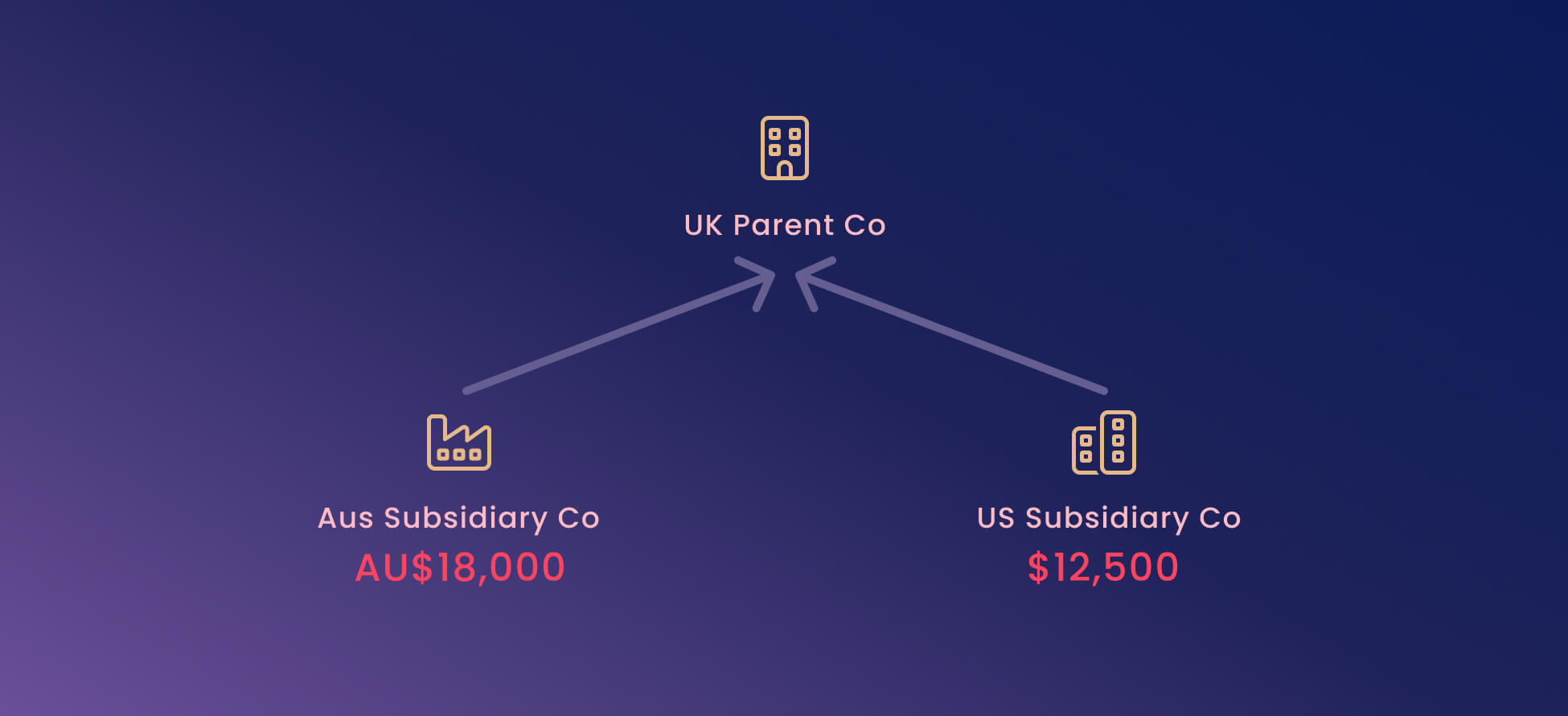
Intercompany loan accounts occur when multiple business entities, usually companies, are connected by shareholding and form a corporate group. Those related entities can be in the same country, or different ones. Intercompany loan accounts reflect monetary balances owed between those entities. They are debt balances rather than any kind of equity.
Each loan exists twice in the group’s books: as a receivable in the entity that is owed the money, and as a matching payable in the entity that owes it. Those two balances are supposed to mirror each other exactly, which is what makes them straightforward in theory and difficult in practice.
How do intercompany loan accounts work?
Related entities won’t necessarily have any balances on their intercompany loan accounts. The following are examples that would create/impact intercompany loan balances:
- Entity A loans money to Entity B
- Entity B makes a repayment of the loan to Entity A;
- Entity A may pay for something on behalf of Entity B;
- Entity A may transfer stock or equipment to Entity B without receiving payment, making a loan in kind;
- Entity A may make intercompany charges of central costs to Entity B, which they decide to let build up as loan balances rather than immediately being paid.
Loans can only be made in one currency. If Entity A is a UK company and Entity B is a US company, they will need to decide whether the loans are made in GBP or USD (or in certain unlikely cases they may choose a third currency altogether).
Interest may need to be charged on the loan balances. The arm’s length principle of transfer pricing is relevant here: what would unrelated third parties do? It’s safe to assume they wouldn’t loan each other money for free!
Intercompany loan accounts vs intercompany current accounts
The two are often used interchangeably, and the distinction is one of intent rather than mechanics. An intercompany current account tends to be used for day-to-day trading between entities and for costs paid on another entity’s behalf, and is expected to be settled reasonably regularly. An intercompany loan account is used for longer-term funding, which is where interest and formal loan terms usually apply.
Whichever you use, the same accounting discipline applies: one account per counterparty in each entity, mirroring the other, so that the two sides can be compared directly at period end.

What happens to intercompany loan accounts on consolidation?
When all is said and done, the intercompany loan account balances should eliminate completely for consolidated reporting. When the group prepares accounts as if all entities were one single entity, intercompany loan account balances should be nowhere to be seen. They relate solely to balances within the group and should therefore net to zero.
This can be a lot easier said than done. Elimination only nets to nil where both sides agree - so any difference between the two balances does not disappear on consolidation, it turns into a consolidation adjustment that somebody has to calculate and explain. That is why intercompany reconciliation is best treated as a monthly control rather than a year-end exercise, and why many groups turn to loan account automation.
How do you reconcile intercompany loan accounts?
Take each pair of entities in turn and compare what one holds as a receivable against what the other holds as a payable. Where the two agree, the pair is reconciled. Where they don’t, work out the difference, trace it back to the transaction responsible, and post the correcting entry in whichever entity is wrong. Then record what you found and what you did, so the same difference isn’t investigated again next month.
Done by hand across a group of any size, this is a long afternoon in a spreadsheet every period. Mayday Balancer, our intercompany reconciliation software, runs the comparison for you: it cross-checks your mapped intercompany loan accounts, flags any discrepancies between them, and surfaces the underlying transactions so you can make the relevant adjustments and keep the accounts in balance.
If you’d like to see how Balancer could take the manual work out of your intercompany reconciliations, sign up for a 30 day no-card free trial today or book a demo with one of the team.