September 16, 2026
Mayday Accruals is Live
Accruals has been one of our most-anticipated additions to Mayday. Today, it’s live.
Learn more
If you are looking for what we lovingly dubbed 'ERPeace of mind', then look no further. Our mission is to empower finance leaders to scale confidently with Xero without the stress of transitioning to complex ERP systems. Let's dive into it.
July 22, 2024

Jessica Chilman
If you’re after what we call ERPeace of mind, you’ve come to the right place. Our mission is to help finance leaders scale confidently with Xero minus the stress of rough ERP migrations. Let’s dive in.
How many businesses run multiple entities using a cluster of accounting files?
Millions.
Yet neither Xero, QuickBooks nor Sage Accounting have designed a platform for managing more than one file.
When tackling a web of financial entities, intercompany transactions, and consolidated reporting, multi-entity organisations need a solution that reduces redundant data entry and simplifies the reconciliation of spreadsheets across siloed databases.
Unfortunately, many cloud accounting solutions don’t make this easy.
This often means organisations either add headcount to cope with manual work or opt for a costly, complex ERP system with high risk and disruption.
There’s no denying it. Xero isn’t designed for multi‑entity businesses.
As companies grow, pressure often builds to switch to a traditional ERP.
But ERP solutions come with high upfront and ongoing costs, rigidity, and disruptive implementations.
Jumping from Xero to a big‑name ERP is a major step.
First, the cost. You could move from under 500 GBP / 1000 AUD per year to many times that amount in software fees.
Then, the implementation costs. Often you’ll spend as much on consulting as the software in year one.
Second, the disruption. Migrating systems takes time and energy, pulling finance teams away from forecasting, pricing, and expansion work.
Let’s be real—no one enjoys migration. Take it from Harriet Hope from Arbolus, a Mayday customer, who described her ERP migration as “horrible and hectic.”
What’s more, Gartner research shows 55-75% of ERP implementations fail.
That means a migration project can leave you worse off than before.
So, what’s the best option for multi‑entity businesses?
The good news: groups can scale with Xero and its ecosystem into growth, avoiding costly ERP migrations.
While Xero’s core model is partner‑driven, it does support in‑house finance teams as they expand and scale.
And upgrading to a more automated setup often means using Xero plus best‑of‑breed apps to plug the gaps.
According to Tyler Caskey, Partner at TheBeanCounters:
“From using Sage Intacct for a global organisation recently, the consolidations in using Xero alongside Mayday, Syft Analytics, Joiin and Fathom are 50% faster. Plus staff prefer the interface—it's more intuitive.”
Even with limited native multi‑entity functionality, the Xero App Store offers plug‑ins to address common pain points.
The result is three‑fold.
Take Paul Gibbons, CFO at Townhouse.
“I was ready to scrap Xero for our 34‑entity business. Within weeks I realised the options were to adapt or switch. After discovering Mayday, we found a perfect fit. Since using Mayday, month‑end cycles reduced from 20 to 10 days for five team members—a huge time saver and peace of mind for accurate reporting.”
Or Natalie Brown, Group CFO at Z Software, who says you should... “Ditch the switch”
“We have 10 companies on Xero. Intercompany loans were a nightmare until Mayday, which has been a lifesaver.”
There are countless stories of finance leaders partnering with best‑of‑breed apps in the Xero ecosystem who find scaling with Xero is more cost‑effective and efficient.
Which brings us to point number 2.
ERP migrations can be so complex and costly that some teams move back to Xero as their preferred solution.
Cathy Collins, Finance Director at Pure Escapes, is a great example.
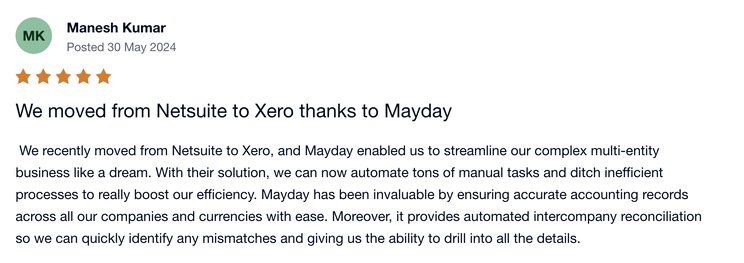
Cathy said: “We were on Netsuite, but Mayday helped us move to Xero for our complex multi‑entity structure. The transition unlocked Xero’s potential, automating countless manual tasks and eliminating inefficient processes.”

And what about other accounting solutions?
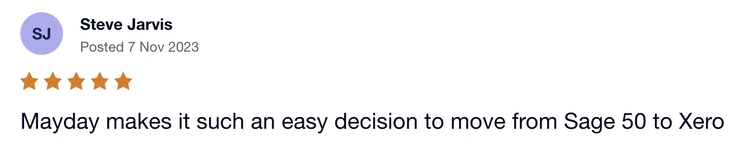
Xero is commonly the preferred solution for multi‑entity businesses, says experienced scale‑up CFO Steve Jarvis.
Steve notes: “A previous business used Sage 50. I wanted a pure cloud system. Xero is clearly superior, but the path isn’t simple. We had to replace or adapt many Sage‑based processes.”
Discovering Mayday made moving from Sage 50 easier, and its automation for multi‑entity needs is vast. The fact it integrates with Xero simplifies the choice of cloud system.
If you’re juggling multiple entities, relax. Rob Buckman says, thanks to best‑of‑breed apps like Mayday, “now Xero really is a multi‑entity solution.”
Next week we’ll dive into success stories, practical tips, and what your group setup on Xero could look like.
Or download a copy of our full 2024 report today.