

Welcome CFO Techstack Community 👋
Last week a room of CFOs asked what finance teams should stop doing. This week, we got together with another room of CFOs, and the question it left us with: who do you actually talk to about the hard stuff?
By hard stuff, we mean working capital shortages, teams too exhausted to take on one more change, and systems inherited through acquisitions or bought before the business needed them.
Do you ask AI? Lean on your industry body? For the people around our table in Sydney, the answer was a little more oldschool. Read in full below.
Also this week, Lakun Agrawal, CFO of Hello Clever, shares how he's built a finance stack that can scale without the team growing at the same rate.
Keep It Simple Until You Can't
Most of us now take our questions to AI first. It's fast, it's always on, and for plenty of questions that's enough.
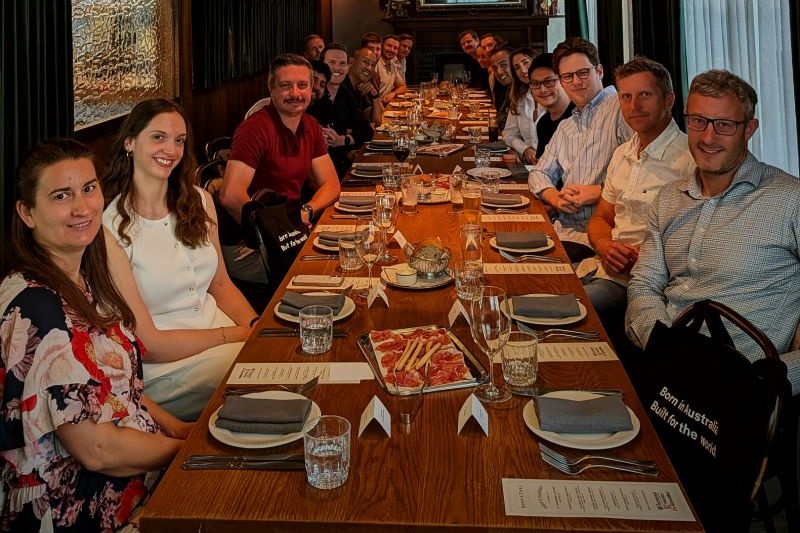
But some things don't come out in a prompt, which is why last week CFO Techstack and Mayday joined forces with global payments platform Airwallex, to host a CFO Roundtable for multi-entity and global businesses.
"The thing that stood out for me was how open and honest everyone was with conversations about navigating working cap shortages. There was willingness to step up, work through those challenges and share knowledge of what has worked and what hasn't." – Philip Fylan, Group Head of Finance at Shootsta
Here's what came up.
Is everyone else this stretched?
If it helps, the answer was yes. You’re not alone.
The room was stretched in two ways: cash and capacity.
Working capital came up openly, and people were willing to share what had and hadn’t worked. And when the talk turned to new systems, several people said the biggest thing stalling change isn’t the software. It’s the team. At this time of year, people are exhausted and committed to existing projects, so even considering a new tool can overwhelm everyone.
One tip: Treat your team's capacity for change as a budget.
Be thoughtful about how you spend it. Pick the one change that matters most, rather than starting three.
Do I really need an ERP?
This one came up again and again: the continued misconception that a growing business needs an ERP. Some in the room had seen teams of fewer than 50 people running NetSuite.
As one investor in the room made clear: "We want to see our portfolio companies focus on growth", not on implementing heavy, outdated tech.
And this stands even for global businesses. Many in the room were running multi-entity, multi-region finance functions... but making it work with apps like Airwallex for global payments and Mayday for intercompany and month-end, around Xero.
"No matter how small-ish or bigger the companies I talk to at events, everyone's issue is always how to keep things simple until you don't have to." – Pascaley Vicario, Financial Controller, Bright & Duggan
So how you do you keep it simple when it feels like the business is only becoming more complex?
- Buy for the business you run now. Size your systems for today and the next stage, not for the company you might be in five years.
- Ask where your investors want your time. If the brief is growth, a long implementation needs a very clear reason to exist.
- Leverage the ecosystem of apps. You may well be outgrowing your existing tools, but before assuming that means you need an ERP, ensure you've exhausted other options in the Xero ecosystem.
If you’re under 50 people and scoping NetSuite, ask yourself: what problem am I actually solving, and does it really need an ERP?
Where does AI fit?
Of course, it wouldn't be a 2026 roundtable without a lot of AI talk, too.
Much like our last roundtable, the room saw AI as a powerful tool to double down on what makes you different. Build those bespoke solutions. Fill those gaps that are unique to you. But for everything else, avoid distraction, buy off-the-shelf.
Amit Shah, Director at Gild Group described what that means for advisers and their clients:
"At a time when it's more possible than ever for administrative tasks to be done in-house, it reinforces our roles to help clients do the things that they're good at and give them options to automate the things that we're good at."
Where are you comparing notes with peers?
The above are just a few of the key points from the day, but the reality is much of the insight remains between those in the room. Not everything can be captured and shared.
So, along with the newsletters you subscribe to (we thank you), the books you read, and the AI tools you prompt...
Don't forget the power of getting together in-person.
"It's always energising to swap real-world stories about the growing pains of scaling, especially globally."
"There was plenty of AI discussion, and it was good to compare perspectives in person."
So, where are you comparing notes with peers?
Start in The Stack Exchange, or come and say hello at one of our Year End Close drinks below.
COMMUNITY INSIGHTS
🎤 How I stacked it
Lakun Agrawal, CFO at HelloClever

Hello Clever is a global fintech building infrastructure to intelligently route money across payment rails and markets.
As CFO, Lakun Agrawal has built a lean, technology-led finance function: automate repetitive processes wherever possible, connect systems rather than rely on spreadsheets, and give the team more time for commercial analysis, capital allocation and supporting growth.
"The objective for me isn't to build a large finance department, it's to build a finance stack that can handle significantly more scale without the finance team needing to grow at the same rate. Do more with less, smartly, efficiently, without errors. That's the goal."
Here is Lakun's tech stack:
- Xero for Core Accounting. The core accounting platform and source of financial data across Hello Clever's entities.
- Mayday for Intercompany. Automates intercompany balancing and reconciliation, keeping accounts aligned and making month end quicker and cleaner.
- Airwallex for International Payments and Spend. Handles foreign payments, internal treasury funding and corporate cards across multiple countries and currencies.
- Fathom for Consolidation and Reporting. Brings multi-entity, multi-currency results together for management reporting, board packs and consolidated reporting.
- Derive for Accounts Payable. Automates invoice processing, approvals and payments, so finance focuses on exceptions rather than processing every transaction.
- Employment Hero for Payroll. Centralises payroll and employee administration, cutting manual work for the finance team.
- Primary for Cash Management. Helps manage surplus company funds and optimise returns while keeping appropriate liquidity.
If you want to showcase your stack contact jack.thiel@getmayday.com
GIVE ME HOPE
Reader’s question:
"We're a UK B2B services company and we're winning more and more work from US clients. Nobody has mentioned sales tax. Should I be worried, and where do I start?"
Felix’s answer:
I've been in a similar situation in a previous role, where our exhilarating US growth had me racing to understand the emerging compliance requirements. I'll happily share my experience, but this isn't tax advice, and engaging a qualified local adviser should be the first step when expanding into any new territory.
Firstly, if you thought UK VAT (or AU/NZ GST for that matter) was complex, welcome to the United States of America! Almost every state has its own sales tax, with thousands of different rates across more than 12,000 jurisdictions. There's very little uniformity, so if you're not already, it's a good idea to start tracking your US clients at state level, as requirements can vary significantly from state to state.
Secondly, you don't need a US office to owe sales tax. Since the Supreme Court's 2018 Wayfair ruling, states can require any business to collect once its sales there cross an "economic nexus threshold". For most states that's $100,000 a year, but California and Texas set theirs at $500,000, and a minority also count transactions, so lots of small sales can tip you over too.
Thirdly, and the bit you'll most want to know: are your services even taxable? In most states, services traditionally haven't been, which is why many businesses assume they're safe. But that's not always the case, and states are regularly widening what they tax. Washington now taxes advertising and IT services, California starts taxing SaaS from January 2027, and if you resell software subscriptions alongside services, that part of the invoice may well be taxable.
Don't worry, there are apps for this (none of which we are paid to mention by the way)! Alongside a trusted tax adviser, if you use Xero in the US, its sales tax feature (powered by Avalara) can apply the right sales tax to your invoices. And newer players like Numeral offer end-to-end sales tax management, including a free tier for monitoring your sales against each state's nexus threshold.
My suggestion: Get ahead of it now whilst it's a manageable admin task, and before it becomes a liability.
Have a question you'd like answered? Submit your questions here.
SPECIAL
Stack Friday is Live!
The biggest accounting techstack sale EVER (or so we think), with savings of up to 90% off, all in one place. Offers end 18th of December.

EVENTS
Social: “Year End Close: Community Drinks” 🍻
🍻🎉👋 December is just around the corner, and that means CFO Techstack community drinks!
- Auckland, Wednesday 2 December: Register your interest
- Adelaide, Thursday 3 December: Book your spot
- London, Thursday 3 December: Book your spot
- Melbourne, Wednesday 9 December: Book your spot [Only a few spots remaining]
- Sydney, Thursday 10 December: Book your spot [Full]
- Perth, Thursday 10 December: Book your spot
Note, spots are limited so please only register if you intend to come along.
📸 Pic below from our Cape Town ‘Year End Close’ event!

[UK] Dinner: CFO Techstack x Ramp: Euro Launch
Last chance to grab a seat at our London dinner 🎟️
Our dinner with Ramp on 1 December is shaping up to be a brilliant evening, with a great group of London finance leaders already confirmed. Due to popular demand, Ramp has generously added more seats to the table.
This is the last chance to get one, so if you’d like to join us, register your interest here.
THE STACK EXCHANGE
🧵 This week’s top threads, from The Stack Exchange
The Stack Exchange is the place to connect with peers, stay on top of the latest apps and industry news, and work through the challenges that don’t have an easy answer.
Want to join the conversation? Sign up free here.
NEW IN THE WORLD OF CFO SOFTWARE
🗞️ News from the stack-o-sphere
- Projectworks brings AI into project finance. Its new assistant, Kea, answers questions and takes actions. A new MCP connector lets Claude, ChatGPT and Copilot work with your Projectworks data. Read more.
- ApprovalMax tightens PO control. Bills can now be matched to their purchase order when they’re raised, and approval rules can use that match status. Read more.
WHAT THE DATA SAYS
📊 Stat of the week
6% of finance leaders say AI has increased the function's workforce size.
27% say it has decreased it.
Compared to 17% and 23% respectively for all functional leaders.
Source: Gartner, reported by CPA Practice Advisor (1,303 senior functional leaders across all functions, Jan-Apr 2026).
MORE OF THE GOOD STUFF
And lastly, our top picks!
🎧 Podcast: CFO Thought Leader, "Nix the Clicks: Building a Finance Function That Manages by Exception". Every Man Jack's finance team stayed at five people while transaction volume tripled.
📝 Article: "CFOs confront cash-flow risks as AI costs rise". Most organisations are overspending on AI, and many can't see the full cost. Tip: budget AI at full cost, including review time, and release funds in stages.
😆 Joke: Why did the CFO pack a passport for month end? Someone said the books were going international.
Why not forward this newsletter to someone you think would enjoy it?
Ready to level up your stack?
Join The Stack Exchange and connect with 500+ finance leaders who are building world-class tech stacks. Share insights, solve problems, and discover the best apps for your needs.
5,000+ subscribers

500+ active members